A Framework by Dr. Petero Wamala
Knowledge Activation
What if the problem is not what we know—but what happens after we know it?
THE KNOWLEDGE ACTIVATION PARADOX
“We have more educated people than ever. And more people paralysed by their own knowledge.”
A person can be highly educated and economically stuck. An organisation can possess excellent research that nobody uses. A university can generate knowledge that never leaves the library. A country can produce thousands of reports while repeatedly confronting the same problems. A business can know exactly what needs to change and still fail to change.
This is the paradox:
The possession of knowledge does not guarantee the productive use of knowledge. Something must happen between knowing and doing.
I call that missing process Knowledge Activation.
The Bridge
Knowledge rarely travels directly from qualification to income, from research to policy, or from expertise to opportunity.
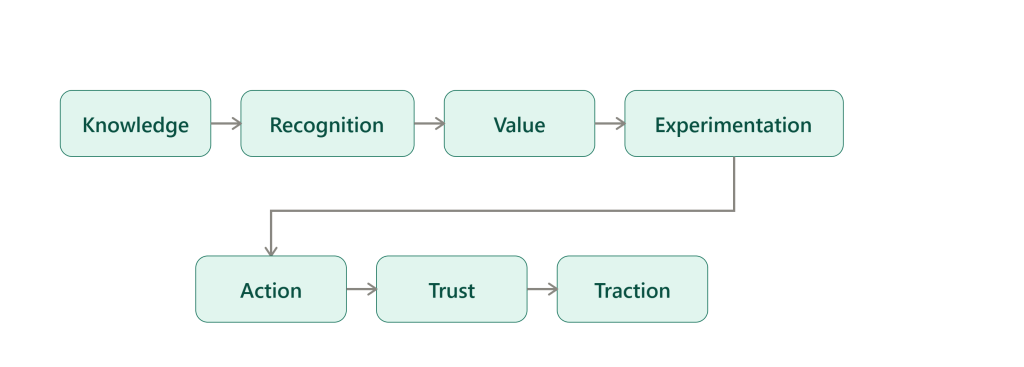
It must be interpreted. Connected to a real problem. Translated into something somebody values. Tested in the real world. Communicated. Improved. Trusted.
Only then does traction begin.
Knowledge Activation studies that journey.
THE SILENT CRISIS OF THE EDUCATED ADULT CHILD
The Most Educated Person in the Room — and the Most Stuck
A son returns from the United Kingdom with a master’s degree. Three years later, his parents are still giving him pocket money.
A daughter possesses excellent professional qualifications but has moved from one short-lived opportunity to another.
Another graduate has ideas, contacts and ability but projects remain unfinished, partnerships collapse and years quietly pass.
The family is confused.
How can somebody who knows so much appear able to do so little with what they know? Perhaps we have been asking the wrong question.
The question may not simply be:
“Why can’t this young person find a job?”
A more useful question might be:
“What is preventing this person’s knowledge, capabilities and interests from being converted into value that the world recognises and pays for?”
That changes the conversation.
NO HUMILIATION. NO LABELS. NO EASY ANSWERS.
How Knowledge Activation Works
Knowledge Activation does not begin with the assumption that an educated adult who has failed to gain traction is lazy. Nor does it assume that another degree, another motivational speech, another job application or another cheque from a parent will solve the problem.
The blockage may lie elsewhere.
There may be a mismatch between knowledge and market opportunity. There may be weak execution habits. Knowledge may exist but remain poorly communicated. The person may be pursuing opportunities for which they are temperamentally unsuited. Family support may unintentionally have removed the urgency to experiment. Or the person may simply never have learned how to convert formal knowledge into something another human being values.
Before intervention comes understanding.
KNOWLEDGE AUDIT
What do you actually know?
Not merely what certificates do you possess.
We examine knowledge, experience, interests, capabilities, networks and overlooked assets.
OPPORTUNITY MAPPING
Where could that knowledge become valuable?
We look outward to problems, people, industries and markets.
VALUE HYPOTHESES
Instead of declaring “I want to start a business,” we ask:
Who has a problem I might be able to solve?
EXPERIMENTATION
Small real-world experiments replace endless planning.
Talk to customers.
Visit the market.
Build something.
Offer something.
Test something.
PROTOTYPE
The idea begins taking physical form.
A service.
A product.
A demonstration.
A small business model.
A portfolio.
Evidence.
TRACTION
We watch for evidence that the world is responding.
Customers.
Referrals.
Revenue.
Partnerships.
Repeat demand.
Employment.
Traction is evidence—not optimism.
MAAMA HARRIET’S DAUGHTER
WHAT MIGHT THIS LOOK LIKE IN REAL LIFE?
(A hypothetical Knowledge Activation journey)
Suppose Maama Harriet comes to Petero. Her daughter completed a diploma in fashion design five years ago. She is intelligent. She has skills. The family has supported her. But five years later there is little evidence of traction.
The first question is not:
“How much money does she need to open a boutique?”
The first question is:
What exactly is going on?
Petero first talks privately with Maama Harriet. Then he meets Harriet herself. If Harriet appears willing, disciplined and ready to participate seriously, the real work begins.
We audit what she knows.
We observe what she can actually do.
We examine what she enjoys.
We study where people are already spending money.
Perhaps two possibilities emerge.
Harriet could build a specialised clothing service. Or perhaps her abilities are better suited to supplying uniforms to schools, companies and organisations.
We don’t immediately invest heavily in either.
We test.
Talk to potential customers.
Visit suppliers.
Cost materials.
Make samples.
Approach prospective buyers.
Observe Harriet working outside the comfort of the meeting room.
The market begins answering our questions.
One path weakens.
Another becomes interesting.
We follow the evidence.
That is Knowledge Activation. Not another seminar. Not another certificate.
Knowledge entering the world.
THE WORLD IS PART OF THE CLASSROOM
PETERO DOES NOT SIT ONLY IN THE OFFICE
I am suspicious of interventions conducted entirely across polished tables in air-conditioned offices. People can rehearse excellent answers. The market is less polite.
Where appropriate, Knowledge Activation therefore moves into the field.
We visit.
Observe.
Talk to customers.
Meet practitioners.
Examine competitors.
Test assumptions.
Watch how the person actually works. Because sometimes the difference between potential and traction becomes visible only when the person encounters the real world.
The Parent Dilemma
HELPING WITHOUT HIDING THE PROBLEM
Parents face an especially difficult dilemma. You love your child. You can afford to help.
So you provide accommodation.
A car.
Pocket money.
Capital for another idea.
Contacts.
Perhaps another course overseas.
Each act is understandable.
But eventually a difficult question must be asked:
Is our support helping activation or protecting everybody from discovering that activation has not occurred? Knowledge Activation does not advocate abandoning adult children. It asks something more intelligent:
How can family support increasingly reward evidence, responsibility, experimentation and progress?
BEYOND THE EDUCATED ADULT CHILD
KNOWLEDGE ACTIVATION IS BIGGER THAN THIS
The educated adult child is one visible expression of a much larger question. Knowledge Activation may also help us understand:
Universities
Why does valuable research struggle to enter society?
Organisations
Why do excellent reports and strategies often remain unused?
Professionals
Why does expertise sometimes fail to translate into opportunity?
Entrepreneurs
Why do people repeatedly accumulate information without testing their assumptions?
Public policy
Why can societies understand a problem for decades without changing it?
And now another extraordinary development raises the stakes.
ARTIFICIAL INTELLIGENCE
AI is making access to knowledge dramatically easier. That may make Knowledge Activation more important, not less. If almost everyone can increasingly access sophisticated knowledge, competitive advantage may shift away from simply possessing information toward the ability to:
interpret it → contextualise it → experiment with it → act on it → create value from it.
That is a fascinating research question.
THE RESEARCH
FROM PRACTICE BACK TO RESEARCH
Knowledge Activation is not intended merely as a consulting label. It is becoming a serious research inquiry.
My doctoral work in Management is exploring the development of a Knowledge Activation Framework—examining the mechanisms through which knowledge moves, or fails to move, from possession into productive application.
The practical work informs the research.
The research sharpens the practical work and the stories help ordinary people participate in a conversation that might otherwise remain trapped inside academic journals.
FROM UNCLE RWAMITI

UNCLE RWAMITI PUTS IT DIFFERENTLY
“My son, knowing how a bicycle works has never carried anybody to the trading centre.”
KNOWLEDGE SHOULD TRAVEL.
From knowledge to story. From story to action. From action to traction.